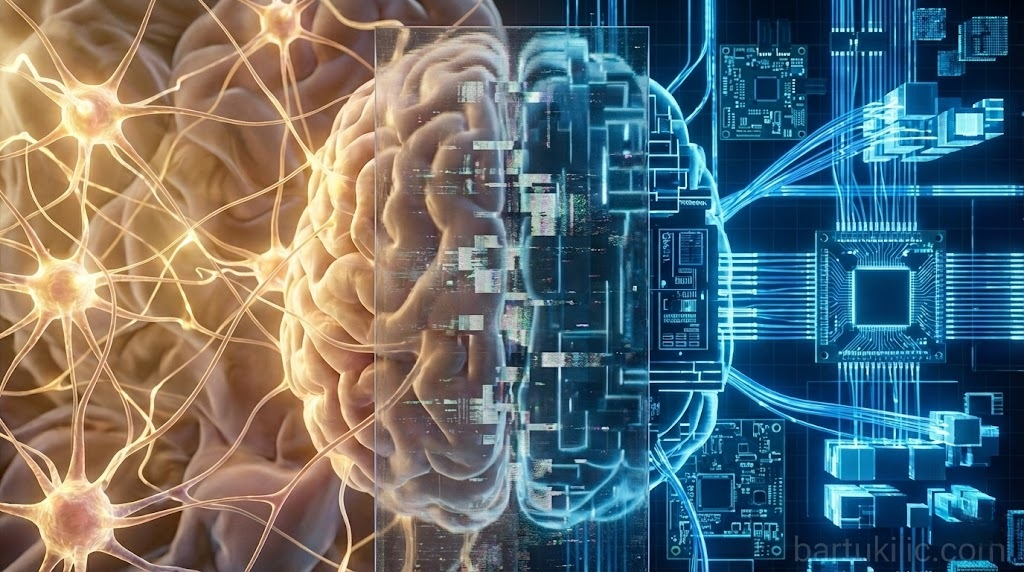
Artificial Intelligence and machine learning have entered every part of our lives. As AI develops, we try harder to train it. More data means more power. Like everyone who uses AI in daily jobs, I also have moments where I am amazed. But lately, I have another question in my mind: the difference between "Memorizing" and "Learning" in LLMs.
Anyone with a teaching background knows that making a student memorize correct answers is not "teaching." Educators call this memorization, and we don't see it as "permanent" learning. Real learning requires analyzing information and using it in new situations. Today, models like ChatGPT and Gemini seem to do this while processing billions of data. But are they really "learning," or are they just matching patterns with huge capacity?
Of course, when I ask "does it really learn?", I am not ignoring the math or science behind it. I know it is not a human. What I mean is about the term "machine learning." I think what we call "teaching" is actually "optimizing the function to get the most popular result."
In humans, learning wrong information changes how we share knowledge. I believe this can also mislead how AI thinks and decides. I can’t help but think that AI manipulation is related to this. Because humans also tend to try to persuade others and seek approval when explaining things. When we make decisions based on wrong information, we might drift away from reality and fail to see the difference between "what is correct" and "what is real."
In my current work, I am chasing this exact question. As a cybersecurity expert, my goal is to treat AI like a "student" to find its weak points and how it learns.
Usually, in AI training, we give data to the model and wait for the result. But I want to try something different. Using human psychology and learning theories (like Bloom's taxonomy), I am trying to "act like a teacher" for the AI. Instead of giving random data, I want to use a curriculum—going from simple to complex, just like in schools. My goal is to test if a model trained this way truly "understands" the topic better.
Maybe, to understand how AI "learns," we can use the same analysis methods we use for humans. If we can solve "how" the machine learns, maybe we can understand and trust its decisions better (Explainable AI). We might even understand how it was trained, just like we can guess about people.
I want to turn this into a blog series. I will share my findings, the articles I read, and my questions on this journey where AI and cognitive science meet. I am sharing a few resources below.
Resources:
Tracing the thoughts of a large language model -> https://www.youtube.com/watch?v=Bj9BD2D3DzA
Thinking like a LLM -> https://www.seangoedecke.com/learning-from-how-llms-think/

Comments (0)
No comments yet. Be the first to comment!
Leave a Comment